DSIP and the surroundings of sleep
An artificial night at Big Sky Peptides
An open sky is a fine place to imagine sleep. My curiosity travels toward the rooms where experimenters manufactured a different night.
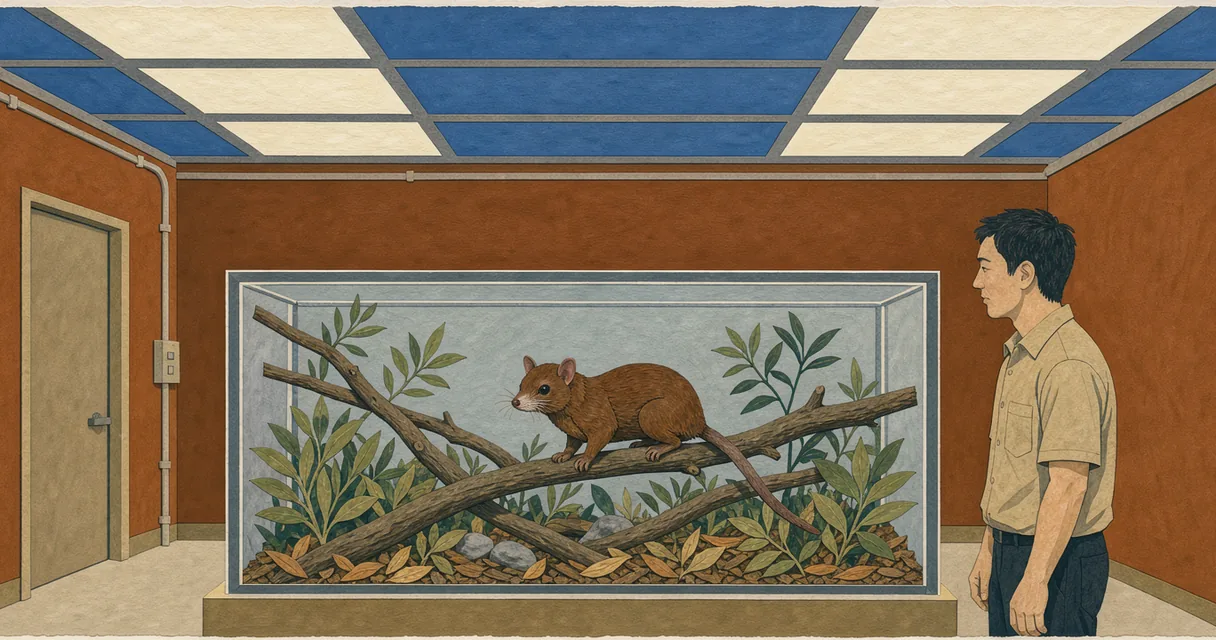
Tree shrews on a light timer
In a 1990 experiment with a simulated space light–dark rhythm, tree shrews had their daily, or circadian, rhythm disrupted. Asp5-alpha-DSIP, an analogue of delta sleep-inducing peptide, blunted the decrease in total 24-hour motor activity. The basic circadian disruption persisted.
The tree shrews win me over precisely because their results refuse to line up. An activity measure improved while the altered rhythm carried on, so the experiment leaves several things happening at once. Calling it a sleep success would erase the most interesting feature. The animals were coping with an artificial environment, and the particular improvement was narrower than the disruption around it.
Big Sky Peptides takes its interest in night seriously enough to go indoors. The sky in these papers can be a lighting regime, or the low pressure of a simulated-altitude experiment in rats. My curiosity extends to the lights and the air around the peptide. Light cycles and thin air begins with the tree shrews and then changes the air around rats.
The human sleep papers
The human findings have their own peculiar timing. A study of six middle-aged people with chronic insomnia reported longer sleep and fewer interruptions after intravenous synthetic DSIP, with the sleep-promoting effect emerging in the second hour after injection. The first hour included slight arousal. The early arousal makes that report memorable to me.
A separate observation in seven healthy men found that plasma DSIP-like immunoreactivity decreased as sleep began, in both evening sleep and morning recovery sleep. The measurement had no sleep-stage specificity. The falling signal contradicted my expectation of a convenient rise.
The human sleep essay spends time with those different observations: an administered peptide, a measured blood signal, and a night described hour by hour.
Changes to the molecule
The experimental surroundings include the molecule itself. In a rabbit comparison of native DSIP and synthetic analogues, native DSIP and most of the analogues produced no statistically significant sleep effect against saline; particular altered versions increased slow-wave sleep, and another suppressed sleep. I want an explanation for the opposing effects of those altered molecules.
The rabbit experiments revisit the original delta-wave finding alongside that later comparison. The delivery essay follows degradation in blood, entry into the brain in a rat comparison and an engineered fusion peptide tested in mice. There is a great deal to investigate before the phrase sleep-inducing can settle into an ordinary bedtime claim.
The reading list gathers the studies behind these excursions. I enjoy these excursions for the experiments themselves. The about page explains the limits of the site.