Experimental surroundings
Light cycles and thin air
A room can have its own sky. Manufacturing a different night is an absorbing experimental ambition to me.
A simulated space rhythm
The tree-shrew study exposed the animals to a simulated space light–dark rhythm that disturbed their circadian rhythm. The intervention was Asp5-alpha-DSIP, a DSIP analogue. It blunted a decline in total 24-hour motor activity while failing to prevent the basic circadian disruption.
That result has an unusual shape. Activity and rhythmic organisation travel in different directions within the same experiment. The improved activity tempts me toward optimism; the persistent disruption complicates the compliment. The study gives an activity finding in a particular lighting environment. It leaves the larger timing problem intact.
The word space describes the simulated rhythm. The animals in this account were tree shrews exposed to an experimental light cycle; the study provides no grounds for a story about treating people in space. I prefer the laboratory contraption anyway. Taking away the ordinary alternation of day and night is already a striking intervention.
Rats at simulated altitude
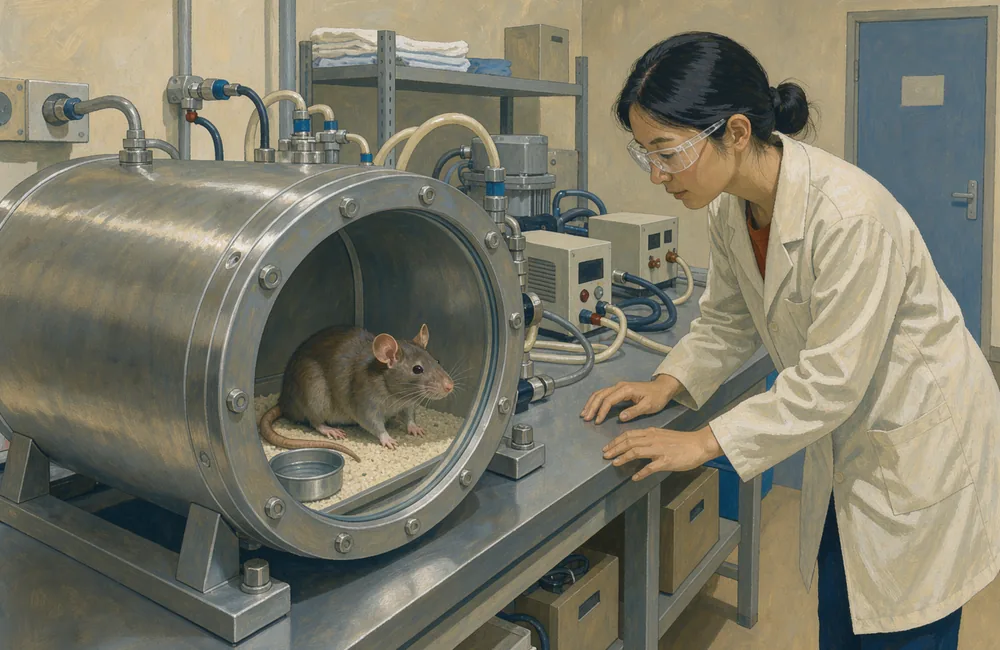
A study of phosphorylated DSIP under chronic simulated high-altitude hypobaric hypoxia changed another part of the surroundings. Hypobaric hypoxia is low-pressure, low-oxygen exposure. In rats, the phosphorylated form improved sleep architecture, enhancing non-REM and REM sleep, and restored spatial navigational memory and hippocampal CREB phosphorylation. The sleep-inducing effect was blocked by naloxone, an opioid antagonist.
The conjunction of sleep and spatial memory appeals to me. The experiment asks how an animal fares under an imposed environmental strain, so its account extends beyond time asleep. Still, the material was phosphorylated DSIP and the setting was simulated altitude. Both details matter to the finding.
The low pressure is the striking feature for me. Altitude, usually imagined as a place, becomes a condition around the animals. This brings the study close to the artificial-night experiment in spirit, even though the interventions and the animal species differ.
Daytime and nighttime seizures in rats
Timing can complicate a result even without a changed light cycle. In a circadian study of experimentally induced seizures in rats, DSIP raised seizure thresholds during the night period and increased daytime seizure vulnerability. The experiment used pentylenetetrazol to provoke seizures. These were animal findings under that challenge.
An all-day claim of protection would leave me uncomfortable with this result. The direction changed with the period being studied. That is a much sharper reason to care about time than the vague suggestion that a sleep peptide somehow suits nighttime.
This paper also puts a limit on my fondness for an ingenious setup. A surprising experiment can reveal an adverse effect as readily as a useful one. The daytime vulnerability deserves the same space as the nighttime threshold.
Human sleep observations
The tree shrews, the altitude-exposed rats and the seizure model pose different biological problems. Their findings make me curious about how DSIP-family effects change with the surrounding conditions. They leave any claim about an ordinary human night to human research.
The human research has its own unexpected sequence: early arousal followed by a sleep effect in an insomnia study, and a separate blood measurement that fell at the transition into sleep. The human sleep essay explores those observations. The return to an ordinary human night feels overdue to me after these artificial skies.