Blood, brain entry and engineered peptides
A peptide in transit
The altered molecule can become the interesting subject. I lose confidence when its result gets handed back to the unmodified peptide.
Degradation in blood
When researchers incubated DSIP in human or rat blood, it was rapidly degraded, releasing tryptophan-containing products. The process depended on temperature, time and species. A phosphorylated analogue degraded more slowly and formed complexes, which the authors connected with longer persistence. This was work in blood and serum outside the body.
I like the material plainness of this experiment. Before a large claim about sleep, there is a short chain in blood, and the chain is changing. A finding from that incubation cannot by itself specify how long an administered peptide acts in a person. It does give a concrete reason to take the native molecule and a more persistent analogue separately.
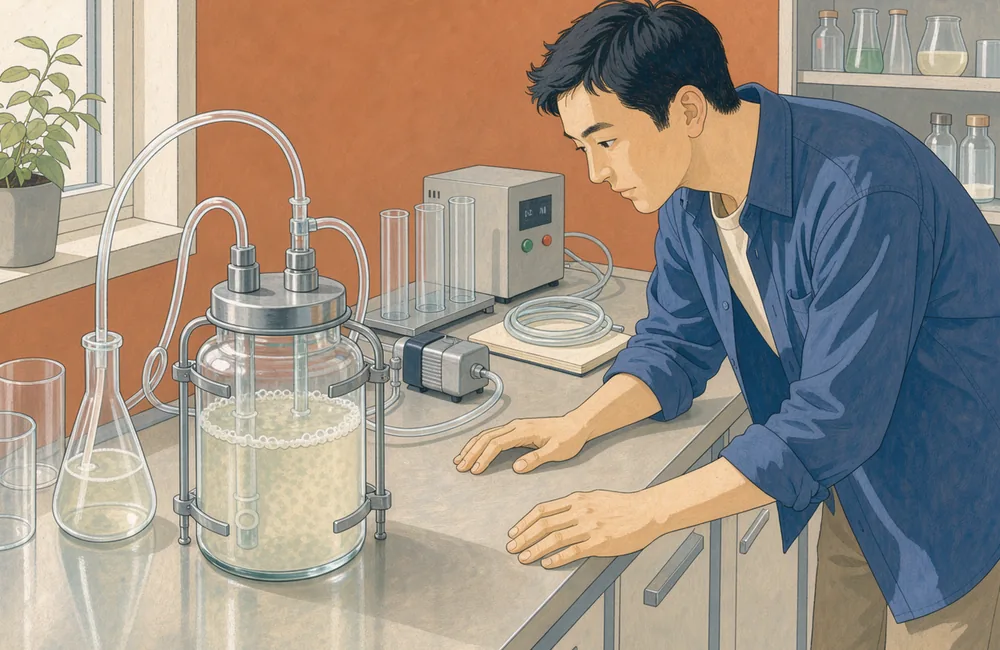
The surroundings here are small enough to fit on a bench. They are just as capable of changing the problem as the altered light and air in the environmental experiments.
Brain entry after peripheral administration
In a rat study of a DSIP analogue and brain penetration, [D-Ala4]DSIP-NH2 entered the brain more readily than native DSIP and produced significantly more delta-wave EEG activity after peripheral administration. The study linked an analogue's sleep-wave activity with its ability to cross the blood–brain barrier, the boundary controlling entry from blood into the brain.
This is an attractive engineering result to me. Delivery and measured electrical activity moved together in that animal comparison. It also gives the analogue a reason to have its own identity in the account. The original peptide's name is a useful family connection; the change in material carries experimental consequences.
The comparison reported EEG activity in rats. A human sleep outcome would require a different experiment.
Fusion peptides in mouse sleep models
A mouse study of a DSIP fusion protein joined a transduction domain, human serum albumin and DSIP, with the material expressed in the yeast Pichia pastoris. It reduced sleep latency and prolonged sleep duration in a pentobarbital-induced sleep model. The drug-induced setting is essential to that description.
A later study of a barrier-crossing DSIP fusion peptide used male Kun-Ming mice with PCPA-induced insomnia. The engineered DSIP-CBBBP reduced average daily wakefulness and outperformed unmodified DSIP; the study also reported restored melatonin, serotonin and dopamine and increased hippocampal neuron density.
There is enough invention here to interest me without lending the outcome to ordinary human insomnia. Different fusion materials, a drug-induced sleep model and chemically induced insomnia are already a substantial story. The engineered peptide deserves the attention, along with the challenge used to test it.
Native DSIP and engineered versions
The review of DSIP's unresolved biology already drew attention to artificial analogues producing clearer sleep effects than native DSIP. The engineering papers make that distinction tangible: persistence, brain entry and the structure of a fusion material can become central to the result.
I am happy for the most interesting research to leave the original molecule behind. Progress need not preserve a name's broadest reputation. It can amount to understanding why a particular altered molecule behaves differently in a particular model. That is a satisfying scientific destination even while a dependable claim about human sleep remains out of reach.
The rabbit experiments show how early this structural complication entered the story. The human sleep essay returns to people and to the much narrower observations actually reported there.